Mojang is working on the third game drop of 2026: Java Edition 26.3. It brings a new autumn forest, a complete new wood set, abandoned camps and a solid pile of furniture. Here is everything that is in it.
When does 26.3 come out?
There is no exact release date yet. Mojang is aiming for the third quarter of 2026, so 30 September at the latest. The first snapshot landed on 23 June 2026. Snapshot 10 came out on 25 August and is the newest version right now. After that you normally get a few pre-releases and release candidates before the final version ships.
The drop was announced at Minecraft Live in May 2026. Bedrock players get the same content through version 26.40 (experimental) and 26.50 (final).
Warning
Everything in this article comes from snapshots. Mojang can still change, rename or drop features before release.
The dappled forest: a new autumn forest
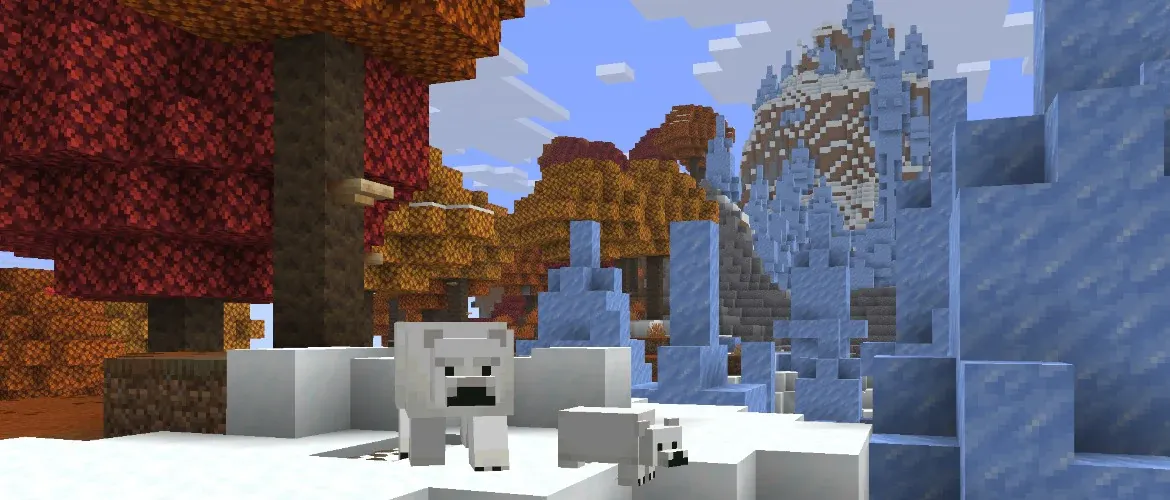
The headline feature is a biome: the dappled forest. An autumn-themed forest you find near cold biomes.
What it looks like:
- Poplars with red, orange or yellow leaves, with the occasional spruce
- Orange-brown grass and coarse dirt underfoot, covered in leaf litter
- Red shrubs and brown mushrooms between the trees
- Fallen poplars generate more often than fallen trees elsewhere, with shelf mushrooms on the trunk
The forest borders plains, sunflower plains, ice spikes and cherry grove, but never another woodland. The size varies a lot: sometimes it is a micro biome of a few blocks, sometimes it stretches for hundreds of blocks.
For mobs you get cold variants of chickens, cows and pigs, plus ordinary sheep, foxes and rabbits. At night, creepers, skeletons, spiders and zombies show up.
Poplar: a complete new wood set
Poplars come with a full wood set, just like oak or birch. You get:
- Logs, stripped logs, wood and stripped wood
- Planks, stairs and slabs
- Doors, trapdoors, fences and fence gates
- Signs and hanging signs
- Buttons, pressure plates and shelves
- Poplar boats, including the chest variant
The leaves come in three colours: red, orange and yellow. Poplar saplings can be planted on dirt, grass, podzol, mycelium, moss blocks and farmland, so you can take the forest back to your own base.
Shelf mushrooms: bouncing on fungi
Shelf mushrooms grow on poplars, in a small and a large variant. You find them on standing and fallen trees in the dappled forest.
What they do:
- You bounce on them. Entities landing on one bounce back with 75% of their impact velocity
- Your fall distance is halved, but you still take damage
- They count as a mushroom in mushroom stew and suspicious stew
- Bone meal grows a small shelf mushroom into a large one
- A small one drops one, a large one drops two
Rather not travel to the forest? The wandering trader sells three shelf mushrooms for one emerald.
Abandoned camps
A new structure joins the game: the abandoned camp. A wool tent with a campsite around it, holding chests, copper chests and barrels.
Abandoned camps generate in eighteen surface biomes, among them bamboo jungle, birch forest, cherry grove, pale garden, savanna, snowy taiga, swamp and taiga. They sit between 8 and 60 chunks apart, 34.5 on average.
The variation is huge. There are ten tent variants per biome, and the campsite has 45 default variants plus four biome-specific ones. Together that works out to 8,820 possible combinations. Cobwebs and leaves sometimes replace the wool stairs of the tent, which makes a camp look even more deserted. You will also run into small crop farms, trees and unlit campfires.
Barrels and regular chests hold the basics: coal, bone, straw beds, arrows and bread, and sometimes a bundle or a fishing rod. Regular chests also carry explorer maps. And then there is the secret chest: a rare, hidden oxidised copper chest with better loot.
Tip
Walk the whole camp and check underground too. The secret chest is not out in the open.
Straw beds: sleep without moving your spawn point
The straw bed is a bed for one night. You craft four of them from three hay bales.
How it works:
- You sleep in it and it breaks in the morning. It drops nothing
- Your spawn point stays exactly where it was
- In the Nether or the End it does not explode like a regular bed. It destroys itself as if you had slept in it
- It stacks up to 16 per slot
- A hoe breaks it fastest
- Villagers ignore them: they will not sleep in one and will not breed near one
You also find straw beds in the barrels of abandoned camps.
Tip
Useful on expeditions. You skip the night without your respawn point ending up hundreds of blocks from your base.
Cushions
Cushions are new furniture you can actually sit on. You craft one from a single matching wool slab, in all sixteen colours, and you can re-dye them later.
What makes them special:
- They have no collision and are allowed to overlap other blocks. Only not with each other
- That means you can place them on things lower than a full block, such as a snow layer or an enchanting table
- While you sit, portals, knockback, geysers and pistons do not affect you
- They are 0.249 blocks tall and stack up to 16
- They burn as fuel: one item smelted per cushion
Cushions also generate naturally in abandoned camps, around the campfire.
Wool and concrete in 16 colours, now as stairs and slabs
Wool and concrete both get stairs and slabs in all sixteen colours.
You craft wool stairs from six wool in the usual stair pattern, and you can re-dye them into another colour. They dampen sound just like regular wool and carpet: put a wool stair between a sculk sensor and the source and the sensor will not pick up the vibration. Walking, sprinting and jumping on the stair itself goes unnoticed too.
Concrete stairs and slabs are crafted from concrete, or cut on the stonecutter.
New explorer maps
Twelve maps join the game. Eight of them point to abandoned camps: Bamboo Camp Map, Birch Forest Camp Map, Cherry Grove Camp Map, Dappled Forest Camp Map, Flower Forest Camp Map, Pale Garden Camp Map, Swamp Camp Map and Windswept Forest Camp Map. The other four point to existing structures: Buried Ancient City Map, Buried Mineshaft Map, Desert Pyramid Map and Warm Ocean Ruins Map.
Several existing maps also get a clearer name:
- Jungle Explorer Map becomes Jungle Pyramid Map
- Ocean Explorer Map becomes Ocean Monument Map
- Swamp Explorer Map becomes Swamp Hut Map
- Trial Explorer Map becomes Buried Trial Chambers Map
- Woodland Explorer Map becomes Woodland Mansion Map
What else is changing
- New world options Force Game Mode and Personal Game Mode. Handy when you play with friends and do not want everyone in the same mode
- New command /compute. Evaluates a
minecraft:number_provider, with a block or entity as context - Faster world generation. Chunk generation has been improved, and /locate finds structures quicker
- Chorus fruit shows particles that indicate which way you are teleporting
- Realms gets an intro screen showing what you can do with it
- New main menu panorama, featuring the dappled forest
Snapshot 10 alone fixed 59 bugs, including one where upgrading a world format could corrupt data.
What about your own server?
Running a Minecraft server? These are the numbers that matter. Note that these are snapshot values and can still change before release.
- Java: Java SE 25 minimum, same as 26.2. Nothing changes on that front
- Data pack format: 118.0 in snapshot 10, against 107.1 in 26.2
- Resource pack format: 97.0, against 88.0 in 26.2
- Data version: 5015, against 4903 in 26.2
That jump in data pack format is a big one. Expect your data packs and resource packs to need work. Things are moving under the hood as well: material rules and material conditions are now data-driven registries, desert wells use the minecraft:template feature type, and a minecraft:randomly_selected placement modifier and a minecraft:volume_match block predicate have been added.
Warning
Do not update your server on release day. Wait until Paper, Spigot, Fabric or Forge have a build for 26.3 and until your plugins and mods have caught up. And back up your world first, always.
In short
Java Edition 26.3 is built around one new forest and everything that comes with it: the dappled forest with poplars, shelf mushrooms and red shrubs. Around that you get abandoned camps with new loot, straw beds for the road, cushions to sit on, and wool and concrete as stairs and slabs in all sixteen colours. There is no exact date yet, but the release is planned for the third quarter of 2026.